Half-Cut Cell Technology (144-Cell Layout)
The panel is divided into two separate, symmetrical upper and lower halves. If you count the cells, there are 24 rows and 6 columns, totaling 144 half-cells.
- Shipping:
Learn More
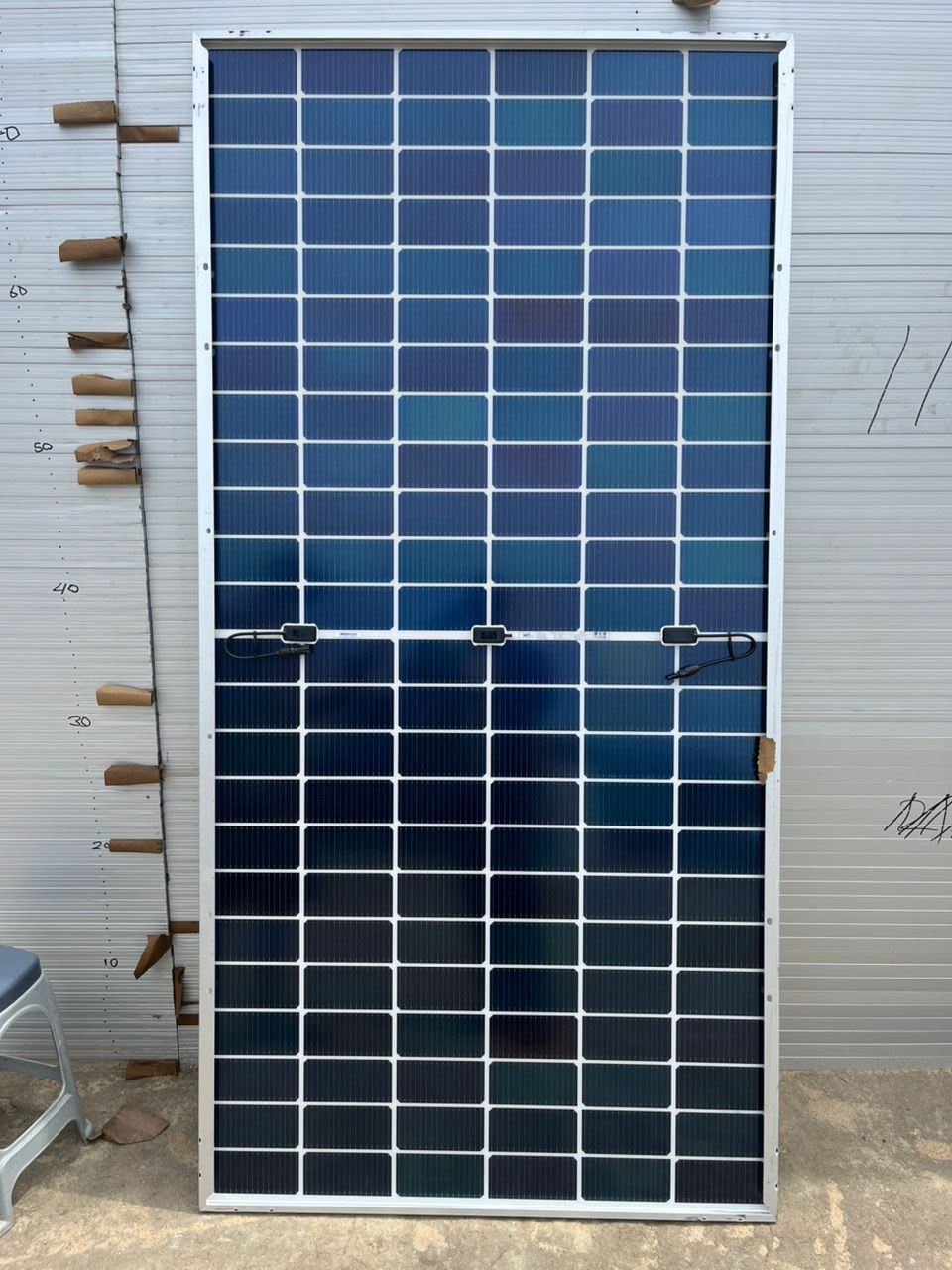
1. Half-Cut Cell Technology (144-Cell Layout)
What it is: The panel is divided into two separate, symmetrical upper and lower halves. If you count the cells, there are 24 rows and 6 columns, totaling 144 half-cells.
Shading Advantage: In a traditional panel, shading just one cell can shut down an entire string or the whole module. With a half-cut design, the upper and lower halves operate independently. If the bottom half gets shaded by debris or a roof lip, the top half continues to generate power at 100% capacity.
2. The Split Junction Box (The 3 Small Center Boxes)
Why it's in the middle: Instead of a single large junction box at the top, this design splits the electronics into three smaller boxes arranged across the center axis.
Thermal & Efficiency Gains: Moving the junction boxes to the center minimizes the length of the internal ribbon wires, which reduces internal resistance and power loss. It also spreads out heat dissipation more evenly, keeping the panel cooler and extending its lifespan. Each box contains a bypass diode protecting its respective section.
3. Bifacial / Dual-Glass Construction
Rear Energy Absorption: The clear gaps between the cells indicate this is a Bifacial panel.
How it works: While the front side catches direct sunlight, the clear glass back absorbs reflected light from the ground, roof surface, or surrounding environment (known as albedo). This rear-side absorption can add an extra 10% to 30% bonus power yield over a standard monofacial panel.
4. Multi-Busbar (MBB) Grid
If you look closely at the blue cell surfaces, you can see multiple very fine vertical silver lines (busbars). Modern panels use 9BB to 16BB (busbars) to shorten the distance electrons have to travel across the silicon cell. This increases overall current flow and makes the panel highly resilient against micro-cracks.