Felicity Solar Inverter (Wall-Mounted)
Power your home or business with the Felicity Solar Wall-Mounted Inverter for clean, stable energy conversion. Ideal for solar setups, it saves space, supports efficient power management, and helps reduce electricity costs with dependable daily performance.
- Shipping:
Learn More
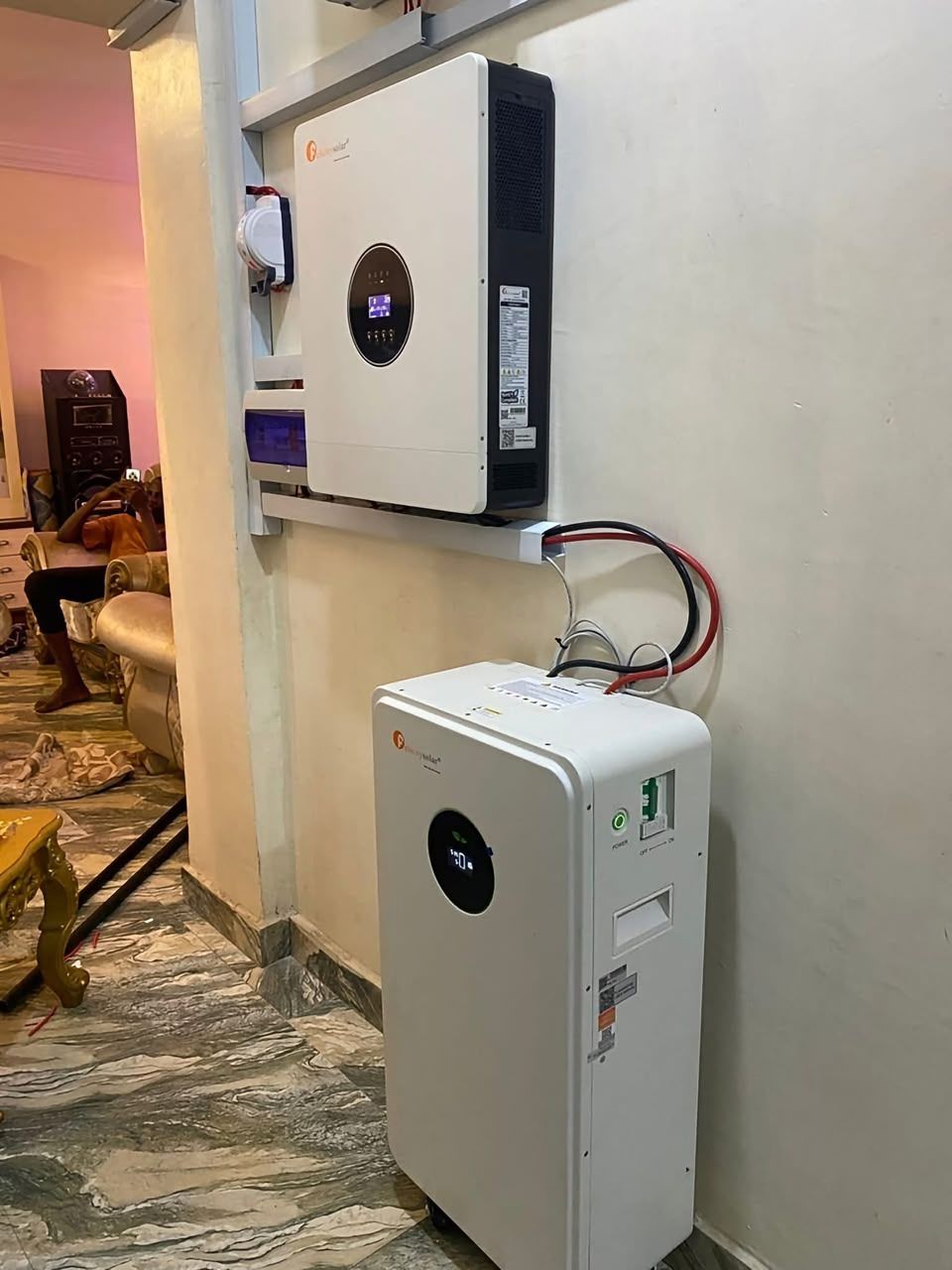
1. The Top Unit: Felicity Solar Inverter (Wall-Mounted)
What it is: This is a high-efficiency Hybrid or Off-Grid Solar Inverter (typically a 48V system, ranging from 5KVA to 10KVA depending on the exact model).
Function: It acts as the brain of the system. It takes direct current (DC) electricity generated by solar panels or stored in the battery and converts it into alternating current (AC) to power household appliances. It also manages the incoming grid power (when available) to charge the batteries or run the house.
Display: The prominent circular LCD screen in the center provides real-time data on power generation, load consumption, battery percentage, and active power sources (Solar vs. Battery vs. Grid).
2. The Bottom Unit: Felicity Solar Lithium Battery (Floor-Standing)
What it is: This is a LiFePO4 (Lithium Iron Phosphate) Battery Pack (most likely a 48V/51.2V 100Ah or 200Ah model, offering 5.12kWh to 10kWh of storage capacity).
Why it’s used: LiFePO4 chemistry is vastly superior to traditional tubular or gel batteries. It offers a deeper Depth of Discharge (DoD) of up to 95%, boasts a lifespan of over 6,000 cycles (lasting 10+ years), and handles high temperatures exceptionally well.
Features: It features a built-in Smart BMS (Battery Management System), an integrated circuit breaker/fuse system for overcurrent protection, and a matching circular digital display showing the State of Charge (SoC).
3. Setup and Wiring Observations
DC Coupler & Cabling: The heavy-duty red (positive) and black (negative) cables connecting the bottom battery to the top inverter are sized correctly for handling high-current DC loads safely.
Trunking & Protection: The neat plastic trunking protects the AC and DC cabling from exposure. To the left of the inverter, you can also see a distribution fuse box/breaker box used to isolate the AC input, AC output, and solar PV array for safety and maintenance.